
“The international community remains silent while Congolese are being killed; they finance Rwanda” Fabrice Malumba, protestor DRC.“The Westerners are behind the looting of our country, Rwanda doesn’t work alone, so they must leave our country,” Pepin Mbindu, protestor DRC.
For weeks, thousands of citizens in the Democratic Republic of the Congo (DRC) have been forced to flee the country seeking refuge in neighboring Rwanda. This follows an escalation of attacks on civilians by the rebel group M23 towards their goal of occupying the strategic city of Goma. In a conflict with roots tracing back to the 1994 Rwanda genocide, the DRC has lost hundreds of thousands of innocent lives and close to seven million people have been forced to flee. Despite promises by the government to neutralize the situation, recent events have shown otherwise.

The DRC is perceived to be the richest country in Africa in terms of minerals. The frequently disputed North Kivu region boasts significant reserves of cobalt, diamonds, and gold. Surprisingly, the country benefits from less than 2% of its resource wealth as approximately 98% is illegally smuggled out of the country. Western powers have been accused of funding neighboring countries and rebels to destabilize the region in order to enable their exploitative activities. Rwanda has faced several severe accusations of supporting the main rebel group M23, claims which the country has dismissed as mere rumors.

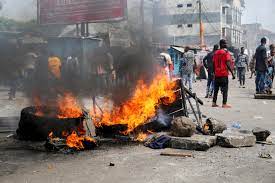
On Monday, August 12th, angry protesters took to the streets of the capital Kinshasa to call out the suspected hypocrisy and foul play of Western powers in the ongoing conflict. Demonstrators burned United States and Belgian flags while also setting tires alight as they targeted Western embassies in the DRC capital. The protesters expressed anger at what they see as Western support for neighboring Rwanda, which has been accused of backing the eastern rebellion.”The international community remains silent while Congolese are being killed; they finance Rwanda” Fabrice Malumba DRC citizen.”The Westerners are behind the looting of our country, Rwanda doesn’t work alone, so they must leave our country,” said Pepin Mbindu,a protestor.
African leaders who were quick to pronounce their allegiances with the warring factions in other conflicts have gone strangely silent on the ongoing conflict in the DRC, despite its importance to African brothers and sisters. One can only speculate as to whether they are waiting for direction from their former colonial masters or if they benefit from the proceeds of this war.
According to reports from Human Rights Watch, the armed rebels in eastern DRC have committed unlawful killings, rape, and other apparent war crimes since late 2022. It is sadly the case that this dire humanitarian situation has not received the attention from the international community or self-proclaimed global “moral police” like the United States that other conflicts around the world seem to garner.
The Congo crisis background- source Eastern Congo Initiative.
The 1994 Rwandan Genocide
In the wake of the 1994 Rwandan genocide in which 800,000 Tutsis and moderate Hutus were killed, millions of Rwandan refugees flooded into the eastern Democratic Republic of Congo.
As a new Tutsi government was established in Rwanda after the genocide, more than two million Hutus sought refuge in eastern Congo.
The UN High Commissioner for Refugees estimates that only 7% of these refugees were perpetrators of the genocide — often referred to as Interhamwe or FDLR (the Federation for the Liberation of Rwanda).
The First Congo War
In 1996 Rwanda and Uganda invaded the eastern DRC in an effort to root out the remaining perpetrators of the genocide.
A coalition comprised of the Ugandan and Rwandan armies, along with Congolese opposition leader Laurent Désiré Kabila, eventually defeated dictator Mobutu Sese Seko.
Laurent Désiré Kabila became president in May 1997 and in 1998 he ordered Rwandan and Ugandan forces to leave the eastern DRC, fearing annexation of the mineral-rich territory by the two regional powers.
Kabila’s government received military support from Angola and Zimbabwe and other regional partners.
The Second Congo War
The ensuing conflict has often been referred to as Africa’s World War with nine countries fighting each other on Congolese soil.
After a bodyguard shot and killed President Kabila in 2001, his son Joseph Kabila was appointed president at the age of 29.
The April 2002 Sun City Agreement, the ensuing July 2002 Pretoria Accord between Rwanda and Congo, as well as the Luanda Agreement between Uganda and Congo, put an official end to the war as the Transitional Government of the Democratic Republic of the Congo took power in July 2003.
In 2006 Joseph Kabila won the presidency in the DRC’s first democratic elections in 40 years.
Leave a Reply