
Is NATO Intent upon
Invoking Article 5 of the North Atlantic Treaty
as a Means to Declaring War on Russia?
Dangerous Crossroads
There are ambiguous statements by Stoltenberg (in his interview with the Washington Post) which suggest that the invocation of Article 5 is on the US-NATO drawing board.
Click to access the full text on NATO’s website

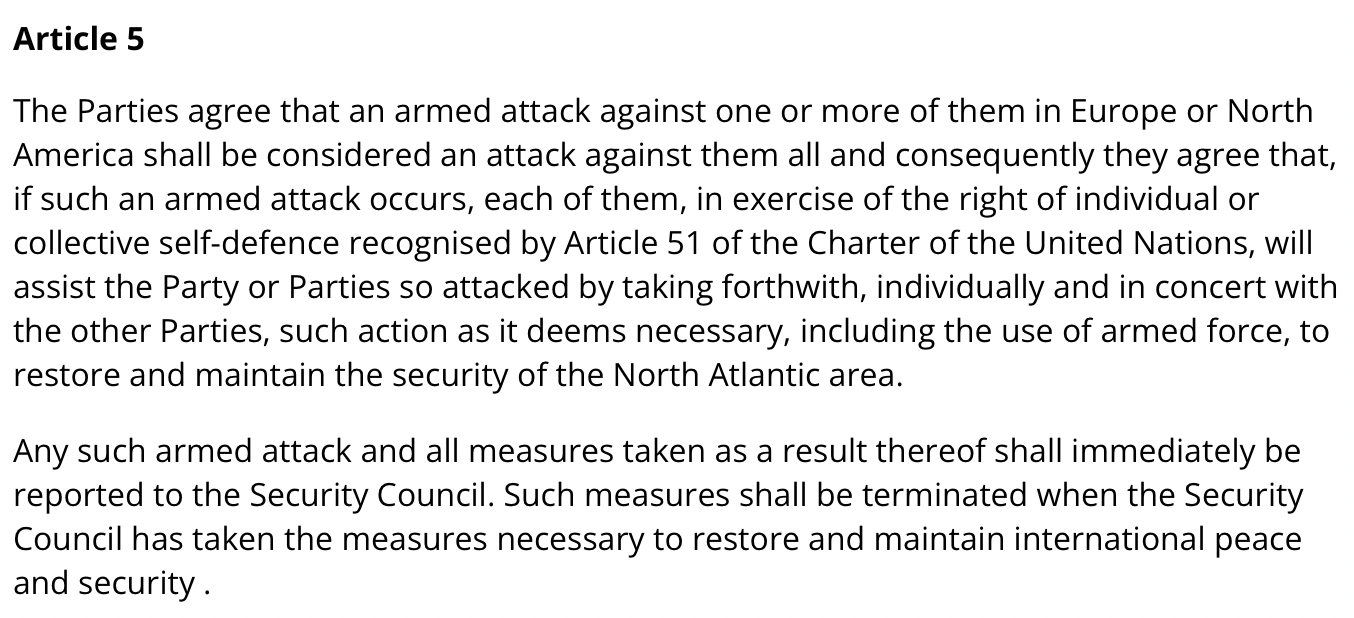
Article 5 of the Atlantic Treaty constitutes NATO’s Doctrine of Collective Self-Defense.
“The Parties agree that an armed attack against one or more of them in Europe or North America shall be considered an attack against them all…”.
Article V was invoked in March 1999, based on a “fabricated pretext” to bomb and invade Yugoslavia.
It was subsequently invoked on September 12, 2001 by the Atlantic Council meeting in Brussels as a justification to declare war on Afghanistan, on the grounds that an unnamed foreign power had attacked America on September 11, 2001.
In both cases (Yugoslavia and Afghanistan), “fabricated pretexts” were used to justify the invocation of Article V.
Fabricating A Pretext to Wage War on Russia?
While Stoltenberg firmly acknowledges that “Russia is not seeking a full-fledged confrontation with NATO triggering Article 5″, he nonetheless intimates that NATO is prepared to invoke Article 5 against Russia, based on a fabricated pretext (e.g attack on “undersea infrastructure”), thereby potentially leading to a World War III scenario.
Lee Hockstader. WP: Would a Russian attack on critical infrastructure like undersea cables owned by NATO members or companies cause the invocation of NATO’s Article 5?
Stoltenberg: That’s for NATO to decide. We are now looking into how can we do more when it comes to sharing intelligence, including with the private sector, to detect any potential threats. …
We’ve seen over the last years that Russia is not seeking a full-fledged confrontation with NATO, triggering Article 5, but they’re trying to operate below the Article 5 threshold. Meaning with hybrid, cyber, covert actions. And, of course, attacks against undersea infrastructure — it’s easy to deny because it’s hard to monitor. (emphasis added)
Stoltenberg’s reference to “undersea infrastructure” intimates that Russia was behind the sabotage of Nord Stream in September 2022, which had been ordered by President Biden with the acceptance of Germany’s Chancellor Olaf Scholz.
What the above statements suggest is that the invocation of Article 5 as well as the use of “a pretext” to wage war on Russia are being discussed behind closed doors.
Stoltenberg claims that NATO is committed to supporting Ukraine (aka the Neo-Nazi Kiev regime) while “preventing escalation” through “increased military presence” as well as confirming that “we are not part of the conflict”:
Stoltenberg: NATO has fundamentally two tasks in the war. One is to support Ukraine, as we do. The other is to prevent escalation. And we prevent escalation by making absolutely clear that we are not party to the conflict, and by increasing military presence in the eastern part of [the] alliance as we have done — with 40,000 troops under NATO command backed by substantial naval and air forces.
Contradictory statement: Is “Preventing Escalation” contemplated by Invoking Article 5?
Among NATO Member States, there are both “Allies” and “Enemies”
It is worth noting that in the course of the last two years, several of America’s European “allies” (NATO member states) whose corrupt politicians are supportive of the Ukraine war, have been the victims of de facto U.S. sponsored acts of economic warfare including the sabotage of Nord Stream.
The EU economy which has relied on cheap energy from Russia is in a shambles, marked by disruptions in the entire fabric of industrial production (manufacturing), transportation and commodity trade..
Specifically this applies to actions against Germany, Italy and France, which have resulted in the destabilization of their national economies and the impoverishment of their population.
See:

NATO/EU Aggression Plunges Germany Into Crisis. “Deindustrialization”
By Rodney Atkinson, August 23, 2023

Video: America is at War with Europe
By Prof Michel Chossudovsky, July 16, 2023
“…the sabotage of Nord Stream was an U.S. Act of War against both Germany and the European Union.
And Germany’s Chancellor was fully aware that an act of sabotage against Nord Stream had been envisaged by the US, to the detriment of more than 400 million Europeans.
A string of corporate bankruptcies resulting in lay-offs and unemployment is unfolding across the European Union. Small and medium sized enterprises are slated to be wiped off the map: “Rocketing energy costs are savaging German industry”… “Germany’s manufacturing industry — which accounts for more than one fifth of the country’s economic output — is worried some of its companies won’t see the crisis through. ….
“Industry behemoths like Volkswagen (VLKAF) and Siemens (SIEGY) are grappling with supply chain bottlenecks too, but it is Germany’s roughly 200,000 small and medium-sized manufacturers who are less able to withstand the shock [of rising energy prices]”
”
“Collective Defense”
In a bitter irony, many of the NATO member states (who are categorized as “allies” under the Atlantic Alliance’s Collective Defense Clause) are the “de facto enemies” of America, victims of U.S. economic warfare.
The practice of so-called Collective Defense under Article 5 constitutes a process of mass recruitment by the 30 NATO member states, largely on behalf of Washington’s hegemonic agenda. It was applied twice in NATO’s history: in March 1999 against Yugoslavia and in October 2001 against Afghanistan.
It constitutes on the part of Washington not only a means to recruit soldiers on a massive scale, but also to ensure that NATO member states contribute financially to America’s hegemonic wars: In other words:
“to do the fighting for us on our behalf” or “They will do the Dirty Work for Us” (Dick Cheney).
What is important is to initiate a coordinated grass-roots movement in all NATO member states to withdraw from the Atlantic Alliance
Neo-Nazism and the Atlantic Alliance
This article has addressed the Unspoken Truth, which we have known all along, from the very outset: “The War Started in 2014”. This statement –which is now acknowledged by NATO–, was the basis of my detailed analysis.
My conclusions are as follows:
The Atlantic Alliance has no legitimacy. It is a criminal entity which must be repealed.
US-NATO is responsible for extensive crimes committed against the People of Ukraine.
What is required is a Worldwide campaign at all levels of society, with a view to eventually dismantling the Atlantic Alliance, while promoting an immediate cease fire and meaningful peace negotiations in solidarity with the people of Ukraine.
Michel Chossudovsky, Global Research, August 27, 2023
Historical Addendum:
The War against Russia Started in January 1918.
From a historical standpoint the US and its Allies have been threatening Russia for more than 106 years starting during World War I with the deployment of US and Allied Forces against Soviet Russia on January 12, 1918, (two months following the November 7, 1917 revolution allegedly in support of Russia’s Imperial Army).
The 1918 US-UK Allied invasion of Russia is a landmark in Russian History, often mistakenly portrayed as being part of a Civil War.
It lasted for more than two years involving the deployment of more than 200,000 troops of which 11,000 were from the US, 59,000 from the UK. Japan which was an Ally of Britain and America during World War I dispatched 70,000 troops.

US Occupation Troops in Vladivostok 1918
Annex
Below are relevant excerpts from Stoltenberg’s Interview with the Washington Post: (emphasis added)
We suggest you access the full text of the interview, click image below

Lee Hockstader, Washington Post Editorial Board: How has the war led NATO to recalibrate its defense posture and doctrine?
NATO Secretary General Jens Stoltenberg: The war in Ukraine has fundamentally changed NATO, but then you have to remember the war didn’t start in 2022. The war started in 2014. And since then, NATO has implemented the biggest reinforcement of our collective defense since the end of the Cold War.
For the first time in our history, we have combat-ready troops in the eastern part of the alliance, the battle groups in Poland, Lithuania, the Baltic countries, actually the whole eight battle groups from the Baltic Sea down to the Black Sea. Higher readiness of our forces. And increased defense spending.
Until 2014, NATO allies were reducing defense budgets. Since 2014, all allies across Europe and Canada have significantly increased their defense spending. And we have modernized our command structure, we have more exercises, we have established new military domains like cyber.
So in totality, this is a huge transformation of NATO that started in 2014.
…
Hockstader: What does a plausible way forward to Ukraine’s eventual membership in NATO look like?
Stoltenberg: First of all, all NATO allies agree that Ukraine will become a member of the alliance. All allies agree that Ukraine has the right to choose its own path, that it is not for Moscow, but for Kyiv, to decide. And thirdly, all allies agree that NATO’s door remains open. Then the question is when, and I cannot give you a timetable on that.
What I can say is that we are now working with them, to help them transition from Soviet-era equipment, doctrines and standards to NATO doctrines and standards, to make their armed forces interoperable with NATO forces, and to help them to further reform and modernize their defense and security institutions.
The urgent task now is to ensure that Ukraine prevails as a sovereign, independent nation, because if Ukraine doesn’t prevail, then there is no issue to discuss at all.
…
Stoltenberg: NATO has fundamentally two tasks in the war. One is to support Ukraine, as we do. The other is to prevent escalation. And we prevent escalation by making absolutely clear that we are not party to the conflict, and by increasing military presence in the eastern part of [the] alliance as we have done — with 40,000 troops under NATO command backed by substantial naval and air forces.
….
Hockstader: Would a Russian attack on critical infrastructure like undersea cables owned by NATO members or companies cause the invocation of NATO’s Article 5?
Stoltenberg: That’s for NATO to decide. We are now looking into how can we do more when it comes to sharing intelligence, including with the private sector, to detect any potential threats. That’s one thing. The other is presence, military presence, as a way to deter but also to monitor.
We cannot protect every inch of every internet cable, but presence helps to reduce the risks and reduce the possibility for Russian deniability. We’ve seen over the last years that Russia is not seeking a full-fledged confrontation with NATO, triggering Article 5, but they’re trying to operate below the Article 5 threshold. Meaning with hybrid, cyber, covert actions. And, of course, attacks against undersea infrastructure — it’s easy to deny because it’s hard to monitor.
*
Click the share button below to email/forward this article to your friends and colleagues. Follow us on Instagram and Twitter and subscribe to our Telegram Channel. Feel free to repost and share widely Global Research articles.
Birds Not Bombs: Let’s Fight for a World of Peace, Not War
The original source of this article is Global Research
Copyright © Prof Michel Chossudovsky, Global Research, 2024
Leave a Reply