

Armed Conflict Events Data
The Six Day War 1967
The Israeli frontier with Syria and Jordan became progressively more tense as the frequency of incidents of shelling, guerrilla attacks and reprisal raids increased after 1960. Tensions mounted even more after 1964 as Israel had nearly completed a massive irrigation project that diverted water from the Jordan River, adversely affecting neighboring Jordan, and Syria planned a project that would cut the water at its source. In November 1966, Egypt and Syria signed a five year defense pact; Jordan and Iraq later joined Syria in its military alliance with Egypt.
In April 1967, six Syrian fighter-bombers were shot down by Israeli fighters; Syria feared an all-out attack from Israel was imminent. Egypt began an extensive military buildup in early May. On May 16th, Egypt asked the United Nations (UN) to remove the UN Emergency Force from the Egyptian-Israeli frontier in Sinai – it had provided a buffer between the warring states since 1956. A few days later, Egypt announced a blockade of Israeli shipping at the Strait of Tiran, an action that Israel had stressed, since 1956, would be tantamount to a declaration of war. Israel now planned a massive preemptive strike while the Israeli government made a series of public declarations that war could be avoided.
On the morning of June 5, 1967, Israel launched a devastating air strike on the air forces of Egypt, Jordan and Syria; the attacks destroyed almost 400 warplanes, mostly on the ground, and established Israeli air superiority for the rest of the war and effectively ensured victory. A ground invasion followed. The Israeli Defense Forces advanced into Egyptian Sinai and the Gaza Strip, the Old City of Jerusalem and the West Bank of Jordan, and the Golan Heights of Syria. The opposing ground forces, lacking any air support while subjected to constant Israeli air strikes, were routed on all three fronts. A UN Security Council (UNSC) sponsored ceasefire ended the war on June 10, 1967. By then, Israel had conquered all of historic Palestine and over one million Palestinians.
‘The traumatic defeat of the Syrians and Egyptians in the war discredited the radical socialist regimes in Egypt and Syria. Jordan, which could least afford it, lost most in the war: as much as half of its agricultural land and its main tourist attractions. About 224,000 Palestinians, many already refugees from the 1948 war, fled the West Bank to Jordan. Israel greatly improved its security from a geographical standpoint and officially annexed the Old City of Jerusalem by the end of June. In November, in response to the war, the UNSC unanimously adopted Resolution 242 calling on Israel to withdraw “from territories occupied in the recent conflict,” for the termination of the state of belligerency, and for the right of all states in the area “to live in peace within secure and recognized boundaries.” Freedom of navigation through international waterways in the area was to be guaranteed, and a just settlement of the refugee problem was to be attained.”
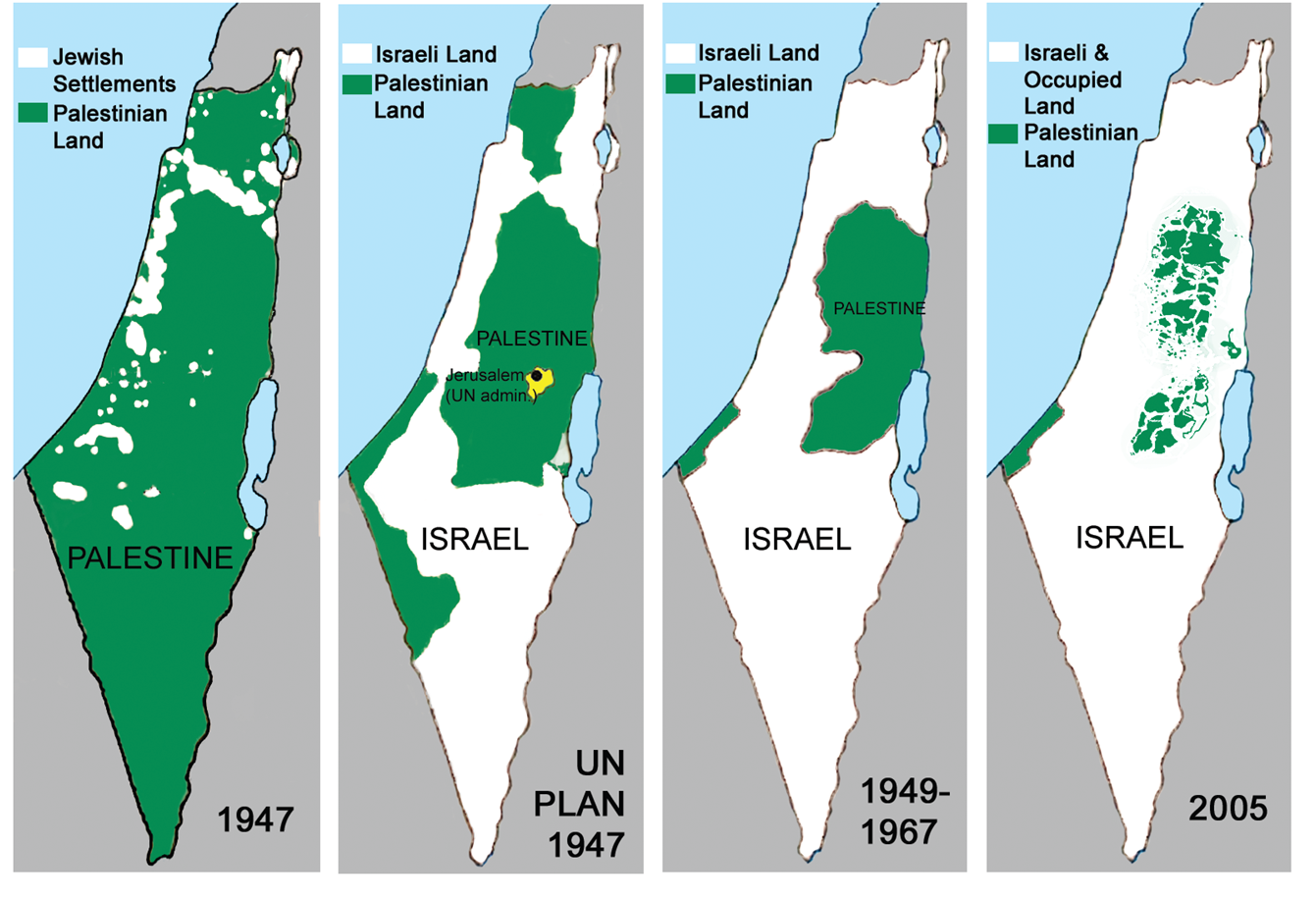
The following maps show how over the years, Israel stole land from the Palestines. Little by little Israel has occupied the majority of Palestine to this date. Netanyahu now wants to wage war to finish what they didn’t get in 1967 in the Six-Day War. See the map of Greater Israel. Netanyahu wants ALL that land.
Leave a Reply