
Building the Third Temple

Lessons from History is a platform for writers who share ideas and inspirational stories from world history. The objective is to promote history on Medium and demonstrate the value of historical writing.
Press enter or click to view image in full size
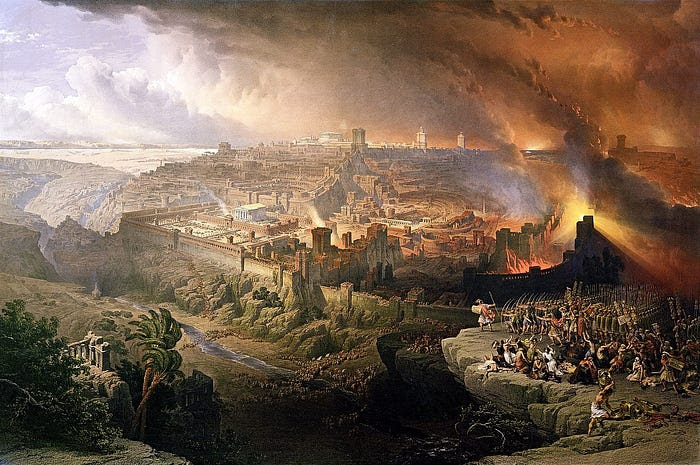
The Sack of Jerusalem and the destruction of the Second Temple by the Romans in 70 AD. By David Roberts, 1850. Public Domain via Wikimedia Commons
The Third Temple simply refused to be built
Krystian Gajdzis
·Nov 1, 2022
One of the holiest sites for the Abrahamic faiths (Christianity, Islam, and Judaism) is the Temple Mount in Jerusalem. It was on this hill overlooking the rest of the city that King Solomon built the first Jewish Temple in 957BC in order to serve as the nucleus for the Israelite faith and as a means to protect the sacred Ark of the Covenant.
Solomon’s Temple would stand firm for centuries before the Sack of Jerusalem by the Neo-Babylonians in 587 BC led to the destruction of the First Temple and the beginning of the era in Jewish history known as the Babylonian Captivity. Eventually, the Jews were granted permission by the Persian Emperor to return to Jerusalem in 516 BC, where they rebuilt Solomon’s Temple to its former glory.
This “Second Temple” would stand for nearly 600 years before the Romans tore down the structure in retaliation for the Great Jewish Revolt in 70 AD. Today, the only surviving section of the once-proud temple is the Western Wall, a holy site visited by millions of worshippers every year.
Considering that the Temple had already been destroyed and rebuilt from scratch once before, why has there been no attempt to rebuild it again? In fact, the idea of a “Third Temple” in Jerusalem arose the moment the Second Temple fell, and many individuals and groups throughout history have tried to lay the foundations for such a grand project. Below are the most prominent attempts to build a Third Jewish Temple, and the reasons why they all failed to deliver results.
132AD- The Bar Kokhba Revolt
Press enter or click to view image in full size

A Watercolor Illustration of Bar Kokhba, by Arthur Szyk, 1927. Licensed under CC BY-SA 4.0 via Wikimedia Commons
In 132 AD, centuries of Roman rule and increasing restrictions on Jewish religious freedom culminated in the Bar Kokhba Revolt, a massive uprising by the Jewish residents of Palestine. Led by Simon Bar Kokhba, a Jewish leader who claimed to be the Jewish Messiah, the rebels managed to seize Jerusalem and its surrounding territories and defeat the local Roman legions sent to quash them.
Flush with the rapid initial success of their uprising, the rebels began the construction of a new Jewish Temple on the site of its destroyed predecessor. Had it been constructed to completion, this new structure would have reversed the traumas inflicted on the previous generation of rebels and provided a rallying symbol for the young Jewish state.
Unfortunately for the ambitions of Bar Kokhba, it appears that these hopes for independence were premature. The foundations for the Third Temple were only just being laid down when Emperor Hadrian arrived with a Roman relief army in 135 AD and defeated the would-be-Messiah in battle. The Bar Kokhbha Revolt was brutally crushed, with more than 580,000 rebels and civilians dying from starvation, disease, and Roman reprisal. The construction site for the Temple was torn down in a concerted effort to remove all elements of Hebrew culture from Jerusalem, ending this first effort to restore Solomon’s Temple.
363AD- Emperor Julian “The Apostate”

A gold solidus of Julian the Apostate, 361 AD. By the Classical Numismatic Group, Inc. Licensed under CC BY-SA 3.0 via Wikimedia Commons
Nearly two centuries after the Bar Kokhba Revolt, another Roman Emperor became involved in the long struggle to rebuild the Temple. Emperor Julian, known as “The Apostate” among early Christians, was the last pagan Emperor of Rome who attempted to reverse the Christianization of the Empire by restoring its traditional religious practices. To this end, he began funding the revival of ancient festivals and rites, including giving permission for the remaining Jews in Jerusalem to rebuild their Temple.
But this sudden reversal in imperial policy was more than just a way to curry favor with one of the Empire’s many faiths- it was also a calculated political move by Julian intended to damage the credibility of Christianity. There was a common belief among bishops and theologians during the 4th century that the Jewish Temple would not be rebuilt until the Second Coming of Christ at the End Times. Julian’s plan thus followed a simple path of logic- if the Jewish Temple was restored BEFORE there were any visible signs of the apocalypse, then the prophecy would be rendered defunct and Christianity would receive a damaging blow to its reputation.
Get Krystian Gajdzis’s stories in your inbox
Unfortunately for Julian and his hopes for a grand pagan revival, it appeared that this prophecy would not be broken so easily. The foundations of the Temple had only just been set down when all the progress on the new Temple was lost by a rather conveniently-timed earthquake in 363 AD, with some accounts also claiming that “fearful balls of fire” shot out from the earth and scorched any workers approaching the site. Besides this potential act of divine intervention, the rebuilding project also never gained the full support of the Jewish people, many of whom did not want their Temple rebuilt by gentiles who had once slaughtered their ancestors. Julian would die in battle later that year, and the returning Christian administration put an end to all attempts to rebuild the Jewish Temple.
614 AD- The Sassanids
Press enter or click to view image in full size

A map of the Byzaantines and Sassanids in 600 AD, just before the outbreak of war. By Getoryk, licensed under CC BY-SA 3.0 via Wikimedia Commons
614 AD would see yet another attempt to rebuild the Jewish Temple, this time sponsored by the Sassanid Persian Empire. The Sassanids had been at war with the Eastern Roman Empire since 602 AD, and their military successes threatened to drive Rome out of Egypt and the Levant. With this dramatic shift in the balance of power in the region, the remaining Jewish residents of Palestine rebelled and joined the Sassanid army under Shahrbaraz in besieging Jerusalem.
Upon taking the city, the Sassanid army allowed the Jewish rebels to not only administer the city but also to restart animal sacrifices and rebuild their lost Temple. This politically-motivated favor parallels the construction of the Second Temple, with the Sassanids reprising the role of their Persian ancestors while the Romans took the place of Babylon. Perhaps, in the same way that Cyrus the Great’s gesture of goodwill restored both an independent Jewish state and the Temple, the rise of the Sassanids would lead to a similar revival?
Fate, however, had other plans. The Jewish rulers of Jerusalem enjoyed their autonomous rule of the city for only a few months before a Christian revolt killed them all and tore down what little work had begun on the Temple. Although the Sassanids retook the city not long after, they replaced the Jewish administrators of the city with native Christians and made no further effort to restart construction on the Temple. The Eastern Romans eventually defeated the Sassanids and restored the city to Roman rule in 628 AD, with the remaining Jewish residents facing persecution and massacres for cooperating with the invaders. In spite of all the initial hopes and positive portents, the only structure remaining on the Temple Mount after the Persian invasion was a garbage dump.
637AD- The Muslim Conquest of Jerusalem
Press enter or click to view image in full size

The Dome of the Rock in Jerusalem, standing where the Second Temple once stood. By Andrew Shiva, licensed under CC BY-SA 4.0 via Wikimedia Commons
The final premodern attempt to begin construction of the Third Temple began with the fall of Jerusalem to the forces of the Rashidun Caliphate in 637 AD. After more than half a millennium of Roman rule, the city now belonged to the still-young Islamic faith, and the Caliph Umar allowed the remaining Jews to once again live inside the city.
With yet another shift in the balance of power in the region, there were hopes that the Caliph would permit the rebuilding of the Third Temple as a means to build strong ties between all three Abrahamic faiths. Umar did intend to develop the Temple Mount, as he was disgusted with the site’s abandoned condition when he toured the newly-conquered city.
Ultimately, this attempt to rebuild the Third Temple never made it out of the planning stages. While Umar did clear out the Temple Mount of all garbage and wreckage, he chose to build a wooden mosque on the site rather than fund another reconstruction attempt. This wooden mosque would later be torn down and replaced in 691 AD by Umayyad Caliph Abd al-Malik, and today it stands as the famous Dome of the Rock and one of the holiest sites in all of Islam.
Modern Attempts to Rebuild the Third Temple
Press enter or click to view image in full size

A modern-day photo of the Temple Mount, with the Dome of the Rock clearly visible. By AVRAM GRAICER, licensed under CC BY-SA 3.0 via Wikimedia Commons
Ever since the creation of an independent Israel in 1948, there have been several attempts to restart interest in rebuilding the Jewish Temple as a sacred place of worship for Judaism. Organizations such as The Temple Institute have lobbied for the resumption of construction on the site, with the Institute even creating menorahs and other items meant to be placed in the Third Temple.
These modern attempts to rebuild the Third Temple never gained any mainstream attention, however, due to the political and religious realities surrounding the project. Rebuilding the Third Temple would require demolishing the Dome of the Rock and other structures now occupying the Temple Mount, something that could never be done without severely infuriating Muslims who considered the Dome to be a holy site. In addition, mainstream Judaism has generally agreed that the Third Temple would not be rebuilt until the coming of the Jewish messiah and see no need to build it earlier. Finally, the idea of building a centrally-located site for Judaism does appear anachronistic to most Jewish sects who consider the faith to have outgrown animal sacrifice and the need for a central Temple.
Thus the current status quo of the Temple Mount will likely remain the same for the foreseeable future, as there is no religious or political need to warrant its construction. But previous attempts have shown that outside powers were willing to get involved despite caring little for the Jewish faith, so it remains to be seen if the Third Temple will truly remain unbuilt until the coming of the Jewish Messiah and/or the End Times.
Leave a Reply